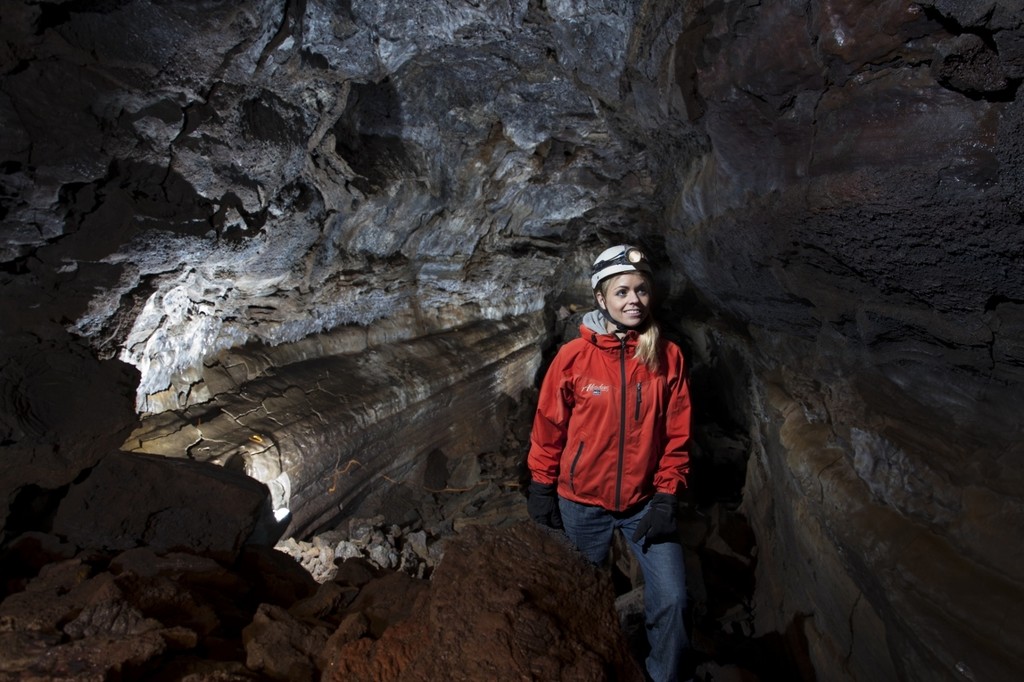
There is only one place on Earth where you can ride an elevator into the heart of a dormant volcano and stand on the floor of its magma chamber. That place is Þríhnúkagígur, a 4,000-year-old volcano in Iceland’s Blue Mountains, just 30 minutes from Reykjavík. This guide covers everything you need to plan your visit: what the tour actually involves, what it costs, what to wear, whether it’s worth the price, and the honest details that competitors and review sites leave out.
If you’re weighing this against other volcanic experiences in Iceland, see our guides to the Fagradalsfjall volcano hike (walk on fresh lava fields) and Eyjafjallajökull volcano tours (glacier-capped stratovolcano on the South Coast).
Þríhnúkagígur Inside the Volcano Tour: Itinerary & What to Expect in Iceland
⏱ Duration: 5–6 hours (with Reykjavík pickup) | 4 hours (self-drive to meeting point) 💰 Price: ~56,333 ISK / ~$400 USD (adult 13+) | ~29,943 ISK / ~$215 USD (child 8–12) 📍 Departure: Reykjavík hotel pickup or self-drive to Bláfjöll ski cabin (Breiðabliksskáli) 📅 Season: May 15 – October 20 (daily departures) 👥 Group size: Max 15–18 per departure, split into groups of 4–6 for the descent ⭐ Rating: 4.7/5 on TripAdvisor (700+ reviews) | 4.6/5 on Viator (240+ reviews) 🔒 Cancellation: Free cancellation up to 24 hours in advance on most booking platforms
What’s included: Guided hike (3.2 km each way), all safety gear (helmet, harness), cable lift descent into the magma chamber, 30–40 minutes exploring inside the volcano, traditional Icelandic lamb soup (vegetarian/vegan available), coffee, tea, and hot chocolate at base camp.
What’s NOT included: Waterproof clothing (you need your own), snacks during the hike, Reykjavík hotel pickup on some booking options (check if it’s an add-on or included).
What Is Þríhnúkagígur? Why This Volcano Is Unique
Þríhnúkagígur (pronounced “three-noo-ka-GHEE-gur”) means “Three Peaks Crater” in Icelandic. It’s a dormant volcano located in the Bláfjöll (Blue Mountains) mountain range on the Reykjanes Peninsula, roughly 20 km southeast of central Reykjavík.
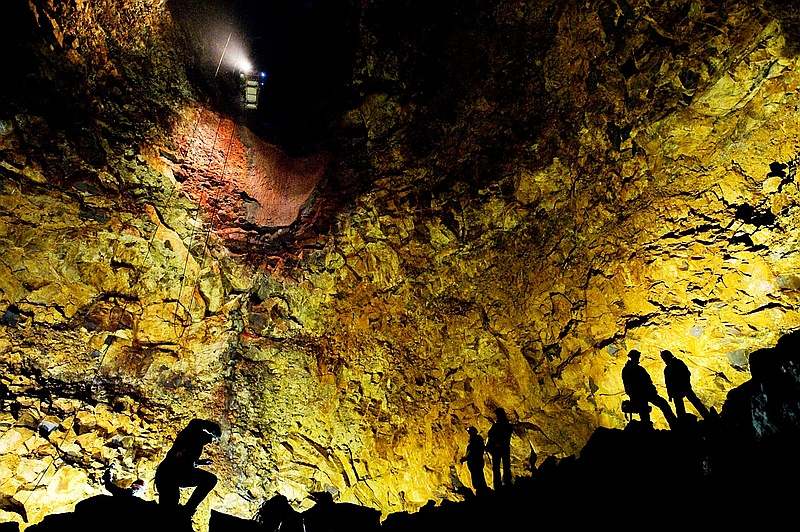
What makes Þríhnúkagígur unlike any other volcano on the planet is simple: when it last erupted roughly 4,000 years ago, the magma drained out of the chamber instead of solidifying inside it. In every other known volcano, the magma cools and hardens, permanently filling the chamber with solid rock. At Þríhnúkagígur, the magma retreated back into the earth’s mantle through underground channels, leaving behind an enormous, hollow cavity.
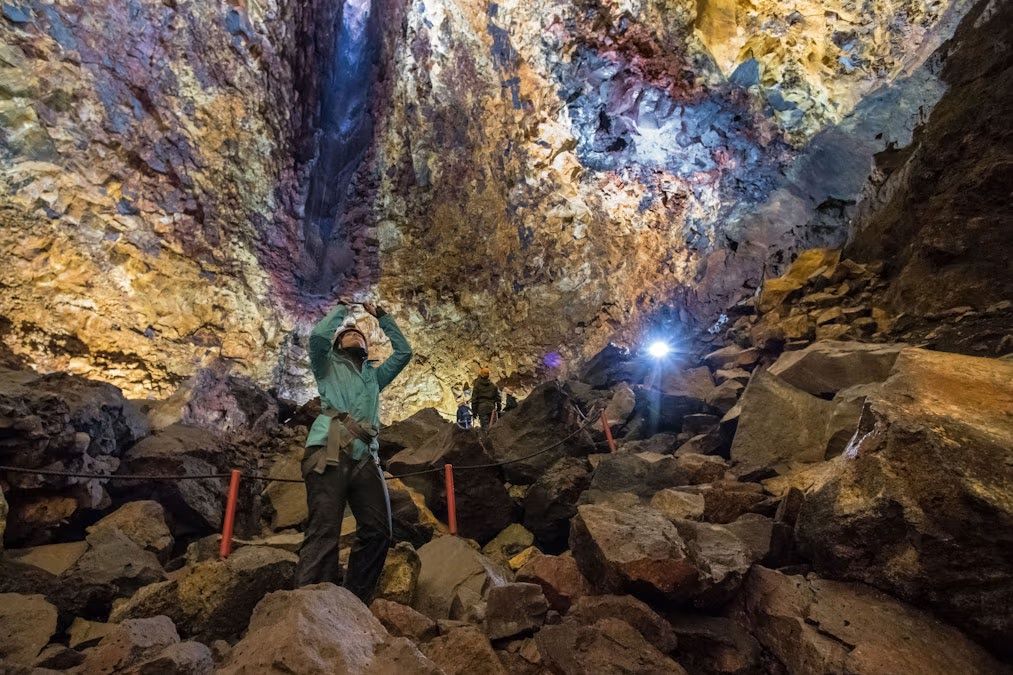
The result is a magma chamber you can physically enter. The chamber is roughly 120 metres deep and about 3,500 square metres across at the floor — large enough to fit the Statue of Liberty standing upright, or roughly three basketball courts. The walls are covered in vivid bands of red, orange, yellow, purple, blue, and green, created by iron, sulfur, copper, and other mineral deposits exposed during the eruption. Visitors consistently describe the colours as “impossible to believe they’re natural.”
The volcano was first explored in 1974 by Árni B. Stefánsson, an Icelandic cave researcher and physician. He spent nearly four decades advocating for public access while ensuring preservation of the chamber. In 2012, his vision became reality when the Inside the Volcano tour officially opened. CNN Travel has since named it one of the world’s must-see experiences.
How Much Does the Thrihnukagigur Volcano Tour Cost? Full Price Breakdown
The Þríhnúkagígur volcano tour cost depends on your age, group size, and whether you add extras like hotel pickup or the helicopter option. Here’s the complete breakdown for 2026.
| Ticket Type | Price (2026) |
|---|---|
| Adult (13+) | ~56,333 ISK / ~$400 USD / ~€370 |
| Child (8–12) | ~29,943 ISK / ~$215 USD / ~€195 |
| Under 8 | Not permitted |
| Helicopter transfer (replaces hike) | Contact operator — significantly higher |
| Waikiki hotel pickup add-on | ~$15–25 extra on some platforms |
What’s included in the price: Guided 3.2 km hike each way, all safety gear (helmet, harness), cable lift descent into the magma chamber, 30–40 minutes exploring the chamber floor with expert guides, traditional Icelandic lamb soup (vegetarian/vegan available), coffee, tea, and hot chocolate at base camp.
What’s NOT included: Waterproof clothing (bring your own), snacks during the hike, gratuity for guides.
Is the Þríhnúkagígur volcano tour cost worth it? At ~$400 per adult, it’s one of Iceland’s most expensive single activities. But it’s also the only place on Earth where you can descend into a real volcanic magma chamber. The cost covers exclusive access (max 15–18 people per departure), 7+ trained staff per tour, helicopter-grade safety equipment, and a geological experience that literally exists nowhere else. Most of the 700+ TripAdvisor reviewers rate it 5/5 and call it “worth every penny.” The most common regret from visitors isn’t the price — it’s not booking it sooner.
How to save: Book directly through the operator’s website (insidethevolcano.com) to avoid third-party markup. Some platforms offer free cancellation up to 24 hours in advance — useful if your Iceland dates are flexible.
The Tour Step by Step: What Actually Happens
Here’s exactly what happens from the moment you start until you’re back in Reykjavík.
Step 1: Transfer to Bláfjöll (30–45 minutes)
If you booked with hotel pickup, a bus collects you from designated stops in central Reykjavík. If you’re self-driving, head to the Breiðabliksskáli ski cabin in Bláfjöll — about a 30-minute drive from the city. Important: avoid the route through Hafnarfjörður (road 417) as it’s permanently closed in that section. Take Route 1 (the Ring Road) instead, which connects to road 417 further along. Free parking is available at the meeting point.
Step 2: Hike Across the Lava Field (45–50 minutes)
From the ski cabin, a guide leads your group on a 3.2 km (2-mile) walk across a moss-covered ancient lava field. The terrain is uneven and rocky but mostly flat — the only real incline is a short 50-metre rise at the very end as you approach the volcano. The pace is steady; guides describe it as “walkable for anyone who can comfortably walk 4 miles on a sidewalk.” You’ll pass small lava caves, volcanic cones, and fissures along the way, with views of the surrounding Bláfjöll mountains.
Step 3: Base Camp & Safety Briefing (15–20 minutes)
A heated cabin sits near the crater entrance with restrooms, coffee/tea/hot chocolate, a small souvenir shop, and Wi-Fi. Your guide gives a safety briefing, and you gear up with a helmet and harness. Groups are split into smaller parties of 4–6 people for the descent.
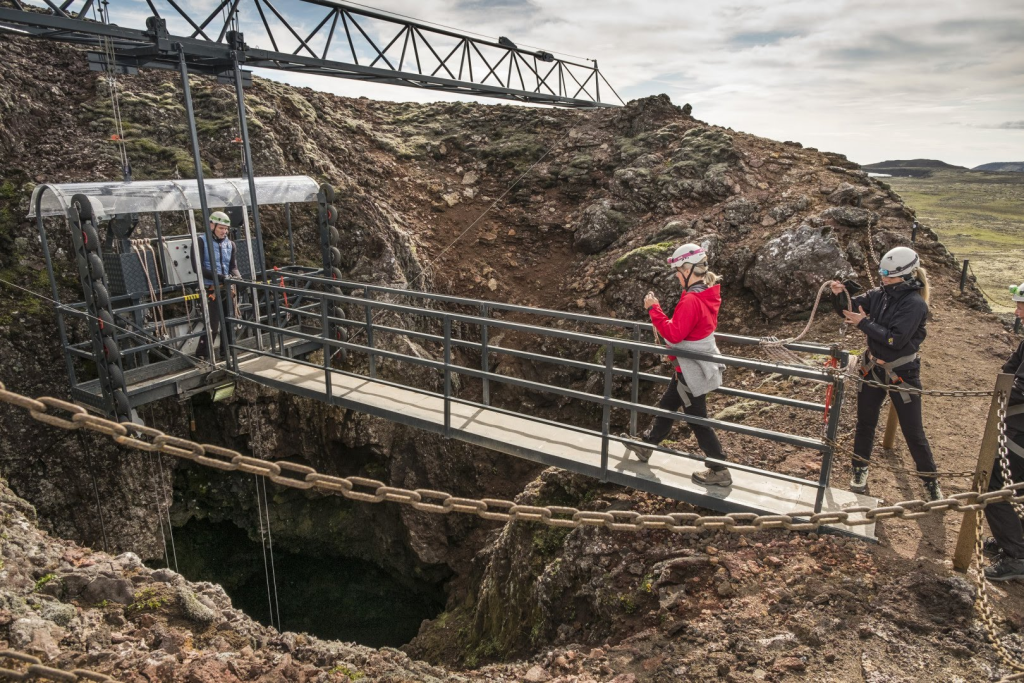
Step 4: The Descent — 120 Metres Into the Volcano (6–7 minutes)
An open cable lift (imagine a modified window-cleaning platform) lowers you through the narrow volcanic vent into the magma chamber. The ride takes about 6–7 minutes — deliberately slow for safety and so you can watch the rock walls change colour as you descend. You’re clipped in with a harness at all times. The lift is operated by experienced mountaineers, many of whom are active members of Iceland’s wilderness rescue squads.
Step 5: Exploring the Magma Chamber (30–40 minutes)
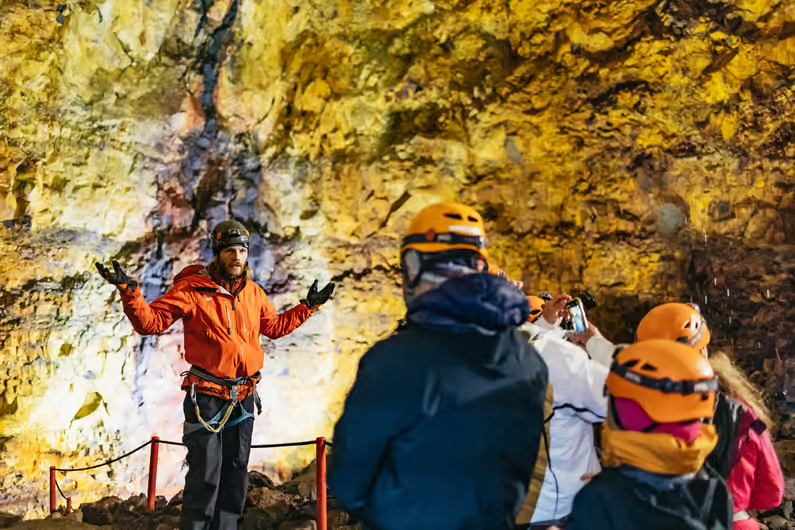
Once at the bottom, you’re free to walk along designated paths through the chamber floor. Expert guides are with you the entire time, answering questions and pointing out geological features. The temperature inside is a constant 3–6°C (37–43°F) year-round. The silence is striking — multiple reviewers describe it as “nature’s cathedral.”
The chamber is strategically lit to highlight the mineral colours on the walls. Photography is encouraged (bring your phone or camera), but note that some visitors report headlamps dying quickly due to the humidity, so a fully charged phone with a flashlight is a good backup.
Step 6: Ascent, Soup & Return Hike (1.5–2 hours)
The lift brings you back to the surface. At base camp, you’re served traditional Icelandic lamb soup (kjötsúpa) — or a vegetarian/vegan option — along with hot drinks. This is included in the price, and multiple reviews single out the soup as one of the highlights (“one of the best lamb soups I’ve had in Iceland”). After eating, you hike the 3.2 km back to the ski cabin, and the bus returns you to Reykjavík.
Quick Facts at a Glance
| Detail | Info |
|---|---|
| Location | Bláfjöll (Blue Mountains), Reykjanes Peninsula, ~20 km SE of Reykjavík |
| Last eruption | ~4,000 years ago (dormant, no signs of reactivation) |
| Depth of descent | 120 metres (400 feet) |
| Chamber floor area | ~3,500 m² (roughly 3 basketball courts) |
| Hike distance | 3.2 km (2 miles) each way, ~45–50 min |
| Hike difficulty | 2/5 — moderate, uneven terrain, short incline at end |
| Time inside volcano | 30–40 minutes |
| Total tour duration | 5–6 hours (with pickup) / 4 hours (self-drive) |
| Season | May 15 – October 20 |
| Departures | Multiple daily: 8:00, 9:00, 10:00, 12:00, 13:00, 14:00, 16:00 |
| Min. age | 8 years (child must be able to complete the hike) |
| Price (2026) | ~56,333 ISK / ~$400 adult · ~29,943 ISK / ~$215 child |
| Safety gear provided | Helmet, harness (worn during descent) |
| Temperature inside | 3–6°C (37–43°F) year-round |
| Guides | 7+ per tour — hiking guides, elevator operators, chamber guides, base camp crew |
| Helicopter option | Available for those unable to hike (~35–45 min flight) |
Is the Þríhnúkagígur Tour Worth $400? Honest Assessment
This is the most common question in every Reddit thread, TripAdvisor forum, and travel blog about this tour. Here’s the honest answer.
Why people say YES, absolutely worth it:
The experience is genuinely unique — there is no other volcano on Earth where this is possible. The visual impact of the chamber is consistently described as jaw-dropping, even by well-travelled visitors. The operation is professional, guides are knowledgeable and safety-focused, and the whole experience (hike, descent, soup) feels complete. Multiple reviewers call it the single best thing they did in Iceland. The phrase “once in a lifetime” appears in nearly every positive review, and in this case it’s literally true.
Why some people hesitate:
The price is steep, especially for families. At ~$400 per adult, a couple spends $800 for what amounts to 30–40 minutes inside the volcano. The hike is pleasant but not exceptional by Icelandic standards. You can’t take rocks as souvenirs. The elevator descent, while exciting, is brief. A few reviewers felt the time inside was too short for the price.
The consensus from 700+ TripAdvisor reviews:
The overwhelming majority rate it 5/5 and use words like “highlight of the trip,” “worth every penny,” and “bucket list.” The most common criticism is not about value but about weather — if you get heavy rain and wind on the hike, the experience before and after the descent is less enjoyable (though the inside is weather-independent). A small number of reviewers felt the explanation inside was too brief and wished the guides had provided more geological depth.
Bottom line: If you can afford it without stretching your budget, do it. If $400 is a significant expense for your trip, understand that you’re paying for exclusivity and uniqueness rather than duration. There is nothing else like this anywhere.
What to Wear & Bring: Practical Packing List
This is where most first-timers make mistakes, based on recurring complaints in reviews.
Footwear
Sturdy hiking boots with good ankle support. This is non-negotiable. The lava field is uneven and can be wet and muddy. Sneakers and casual shoes are not appropriate. Multiple reviewers who wore insufficient footwear regretted it.
Clothing — layer for two environments
- Outside: The hike is at mountain altitude and Icelandic weather is unpredictable. Even if Reykjavík is sunny, expect wind, rain, or both in Bláfjöll. Wear a waterproof outer layer (jacket AND trousers), a warm mid-layer (fleece or wool), and a moisture-wicking base layer. Avoid cotton — it stays wet and cold.
- Inside the volcano: A constant 3–6°C. You’ll want the same warm layers, plus gloves are appreciated.
The jeans controversy: Some booking descriptions say “jeans are not allowed due to humidity.” In practice, many visitors hike in jeans without issue — the concern is that wet denim in cold wind becomes miserable. Waterproof trousers over jeans work fine. The tour operators provide long rain slickers you can borrow, but they don’t cover legs.
Bring
- Fully charged phone/camera (for photos inside — the colours are extraordinary)
- Small backpack for layers
- Water (there’s no water station on the hike, only at base camp)
- Snacks if you tend to get hungry — the soup comes at the end, and some reviewers wished they’d had something during the hike
Don’t bring:
- Tripods or professional camera rigs (limited space in the elevator and on the chamber floor paths)
- Photochromic/transition lenses (they behave unpredictably inside the volcano — wear regular glasses or contacts)
Claustrophobia & Fear of Heights: Can You Still Do It?
This comes up constantly in forums, and the answer from people who’ve done it with these fears is reassuring.
Claustrophobia: The magma chamber itself is enormous — 3,500 m² with high ceilings. Multiple reviewers with claustrophobia report feeling completely fine once inside. The only potentially tight moment is the descent through the narrow crater vent, but it opens up quickly and the ride is only 6–7 minutes. One TripAdvisor reviewer wrote: “I am afraid of heights and a bit claustrophobic. I made the ride down the small, narrow lift without any problem! Once down in the volcano there is no sense of being trapped.”
Fear of heights: The open cable lift is the challenge point. You’re descending 120 metres in an open-cage platform, and you can see the walls moving past you. However, the lift moves very slowly, and you’re securely clipped in with a harness. Looking up instead of down helps. The vast majority of height-averse visitors report managing it well.
If you’re unsure: The helicopter option bypasses the hike but still involves the elevator descent — there’s no alternative way into the chamber.
How to Get There: Logistics & Transport
Option 1: Bus pickup from Reykjavík (recommended for most visitors) Available as an add-on when booking. The bus departs from designated hotel stops and gets you to the Bláfjöll ski cabin in roughly 30–45 minutes. This is the most popular option and what the tour operators recommend — it removes the need to navigate and park.
Option 2: Self-drive to the meeting point Drive to Breiðabliksskáli ski cabin in Bláfjöll. Free parking available. Take Route 1 (Ring Road), then connect to road 417. Do NOT approach via the Hafnarfjörður section of road 417 — it’s permanently closed. The drive from central Reykjavík takes about 30 minutes. If you choose this option, your total tour time is roughly 4 hours instead of 5–6.
Option 3: Helicopter For visitors unable to complete the hike, a helicopter transfer to the volcano is available. Flight time is roughly 35–45 minutes. You still descend via the cable lift. Contact the operator (insidethevolcano.com) directly for helicopter pricing — it’s significantly more expensive.
Best Time to Book & Seasonal Tips
The season runs May 15 to October 20. Outside these dates, snow and ice make the hike unsafe, and all equipment (elevator, cabins, crane) is removed from the site for winter.
Peak season (June–August): Best weather for the hike, longest daylight, but tours sell out fast. Book 1–2 weeks in advance minimum. July is the busiest month.
Shoulder season (May, September–October): Cooler, windier, higher chance of rain on the hike. However, the inside of the volcano is weather-independent, so the core experience is identical. Fewer crowds and easier availability. Some visitors prefer shoulder season specifically because the lava field in autumn fog has its own dramatic beauty.
Pro tip from reviewers: The morning departures (8:00–10:00) tend to have calmer weather than afternoon slots, and you’ll have the rest of your day free in Reykjavík.
Þríhnúkagígur vs. Other Iceland Volcano Experiences
| Experience | What You Get | Unique Factor | Price (2026) | Duration | Fitness Level |
|---|---|---|---|---|---|
| Þríhnúkagígur (Inside the Volcano) | Descend into a real magma chamber via cable lift | Only accessible magma chamber on Earth | ~$400 | 5–6 hrs | Low–moderate |
| Fagradalsfjall Volcano Hike | Walk on lava fields from 2021–2023 eruptions | Fresh volcanic terrain, still steaming | Free (self-guided) to ~$150 (guided) | 3–8 hrs | Moderate–high |
| Eyjafjallajökull Glacier Tour | Super jeep or snowmobile on the glacier that caps the 2010 volcano | Stand on the volcano that stopped Europe | ~$250–400 | 4–8 hrs | Low (super jeep) to high (summit) |
| Lava Tunnel Tours (Raufarhólshellir, Víðgelmir) | Walk through a lava tube cave | Underground lava formations | ~$50–80 | 1–3 hrs | Low |
| Volcano Helicopter Tour | Aerial views of Reykjanes eruption sites | See active lava fields (if erupting) | ~$350–600 | 45–60 min | None |
Key distinction: Lava caves and lava tunnels are impressive but fundamentally different from Þríhnúkagígur. A lava tunnel is a horizontal tube created by flowing lava. Þríhnúkagígur is a vertical descent into an actual magma chamber — the place where molten rock accumulated before an eruption. The two experiences are not comparable in scale, access method, or geological significance.
Combining the Tour with Other Activities
Þríhnúkagígur’s proximity to Reykjavík makes it easy to pair with other experiences on the same day or trip.
Same day (if you take an early departure)
- Blue Lagoon — roughly 30 minutes from Bláfjöll. A post-volcano soak is a popular combination.
- Reykjavík city — you’ll be back by early afternoon if you take the 8:00 AM departure.
Same trip
- Fagradalsfjall volcano hike — different day, on the same Reykjanes Peninsula. Fresh lava fields vs. ancient magma chamber makes for an excellent contrast.
- Golden Circle — different direction (northeast of Reykjavík) so plan it for a separate day.
- South Coast (Eyjafjallajökull, Skógafoss, Seljalandsfoss, Reynisfjara) — full day trip, separate from Þríhnúkagígur.
Common Mistakes to Avoid
Based on hundreds of reviews and forum posts, these are the things people wish they’d known:
- Underestimating the weather on the hike. The inside of the volcano is weather-independent, but the 45-minute walk each way is fully exposed. Even in summer, heavy rain, wind, and cold are possible. Bring proper waterproofs — not just a light jacket.
- Wearing the wrong shoes. Hiking boots, not sneakers. The lava field is rocky and can be slippery when wet. This is the most repeated piece of advice in every review.
- Not bringing water or snacks for the hike. The soup and hot drinks come at the end, after the volcano. There’s coffee/tea at base camp before the descent, but nothing during the hike itself. If you’re hiking in the morning, bring something.
- Expecting a long time inside. You get 30–40 minutes on the chamber floor. It feels adequate for most people, but if you imagined spending hours exploring, recalibrate your expectations.
- Forgetting the 24-hour cancellation policy. Weather in Iceland can cancel plans fast. Most booking platforms offer free cancellation up to 24 hours before — use this flexibility. If you’re booking for a specific date, have a backup day in your itinerary.
- Trying to visit without a tour. There is no way to enter the volcano independently. The only access is via the tour operator’s cable lift, which is removed entirely in winter. The crater opening from above is a 120-metre vertical drop — it’s a bottomless hole, not something you can scramble into.
FAQ: Þríhnúkagígur Volcano Tour
Is Þríhnúkagígur safe? Could it erupt?
The volcano has been dormant for 4,000 years with no seismic signs of reactivation. While no volcano can be declared permanently extinct, scientists see no indications of Þríhnúkagígur becoming active in the foreseeable future. All safety equipment is approved by Iceland’s Occupational Safety and Health Administration. Guides are trained mountaineers, many from Icelandic rescue teams.
Can children do the tour?
Minimum age is 8. Children aged 8–12 pay the child rate (~$215). The child must be physically able to hike 3.2 km each way on uneven terrain in potentially challenging weather. Contact the operator if you’re unsure about your child’s ability.
Is it accessible for people with mobility issues?
The 3.2 km hike on uneven lava terrain makes this difficult for anyone with significant mobility limitations. The helicopter option eliminates the hike but still requires the cable lift descent and walking on the chamber floor (rough, uneven surfaces with roped paths). Contact the operator to discuss specific needs.
Can you take the tour in languages other than English?
Tours are guided in English. Some tour operators may offer private tours in other languages on request.
How far in advance should I book?
In peak season (June–August), book at least 1–2 weeks ahead. Tours do sell out. Shoulder season is more flexible, but advance booking is still recommended.
Is there a weight limit?
There’s no official weight limit for the elevator. However, the operator notes that the 6.4 km round-trip hike on a lava field requires moderate fitness, so the real limiting factor is the hike rather than the lift.
Can I visit the Blue Lagoon on the same day?
Yes — the Blue Lagoon is roughly 30 minutes from Bláfjöll. If you take an early Þríhnúkagígur departure, you can easily fit in an afternoon Blue Lagoon session.
What if it rains?
The tour operates rain or shine. The inside of the volcano is weather-independent — you may get a few drips from the crater opening but nothing significant. The hike, however, is fully exposed. The tour operator provides long rain slickers you can borrow. Bring your own waterproof trousers and boots.
How do I get to the Þríhnúkagígur volcano entrance?
Most tours to Þríhnúkagígur start with a pickup in Reykjavik, or you can drive to the meeting point at the basecamp near the Blue Mountains. From there, you’ll hike to the volcano — a 3km uphill trail (about 2 miles) across breathtaking scenery that takes roughly 40 minutes. A mountaineer guide leads the way, so no experience is needed.
What happens when you descend into a dormant volcano?
After a safety briefing at the volcano entrance, you step onto an open cable lift for a slow descent 120 meters (400 feet) into the magma chamber — that’s deep enough to fit the Statue of Liberty inside. The otherworldly colors on the walls formed when lava cools and solidifies over 4,000 years, creating a one-of-a-kind natural wonder found nowhere else on planet Earth.
Is the Inside the Volcano tour a must-do in Iceland?
Absolutely. Going inside a dormant volcano is an unforgettable, one-of-a-kind experience — it’s regularly listed among the top things to do in Iceland alongside the Golden Circle. The mesmerizing colors of the magma chamber and the breathtaking scenery on the hike to the volcano make it a must-do for anyone looking for a unique volcano in Iceland experience.
Are there similar tours to the Þríhnúkagígur Inside the Volcano tour?
There are no similar tours anywhere on Earth — Þríhnúkagígur is the only volcano in Iceland (and the world) where you can descend into a real magma chamber via elevator. Other guide to Iceland volcano experiences include lava tunnel walks and eruption site hikes, but none offer the same slow descent into the heart of a dormant volcano. This is truly a one-of-a-kind natural wonder.
What does the full itinerary look like?
The inside the volcano tour itinerary starts with pickup or a drive to the meeting point at basecamp. After a briefing, you hike about 3km (roughly 1 kilometer uphill) through breathtaking scenery for around 40 minutes. At the volcano entrance, you board the open cable lift for a slow descent 120 meters down. You spend about 30 minutes inside the chamber before riding the elevator back up and hiking to basecamp.